
Mark Blackman
Mark Blackman sees both Insured and Self-Funding patients at The Oaks Hospital.
Please inform his secretary if you have had any previous or relevant imaging. We can request transfer of imaging or outpatient events from some other hospitals.
When booking a procedure or operation please contact the secretary for fees. Please remember that the anaesthetists fee and the hospital fee will also apply.
Contact Mr Blackman’s Secretary for more information and appointments.
Steroid injections are a common treatment option for many forms of low back pain and leg pain. They are still an integral part of the non-surgical management of sciatica and low back pain. The goal of the injection is pain relief. Following this a comprehensive rehabilitation program is provided to increase core strength, posture and mobility.
The effects of the injections vary in duration – providing relief from pain for one week up to one year. A steroid injection can therefore be very beneficial for a patient during an acute episode of back and/or leg pain. It can provide sufficient pain relief to allow a patient to progress with a rehabilitative stretching and exercise program. If the initial injection is effective for a patient, he or she may have up to three in a one-year period.
Several common conditions that cause severe acute or chronic low back pain and/or leg pain (sciatica) from nerve irritation can be treated by steroid injections. These conditions include:
1-3 weeks prior to your procedure
On the day of your procedure
In my practice injections are typically provided as daycare (no requirement for an overnight stay).
In the operating theatre an X-ray machine (fluoroscope) is used and the patient is sedated by an anaesthetist to provide pain relief and to avoid anxiety or stress.
Please advise us if you think you might be pregnant!
X-rays during pregnancy carry a risk of exposing an unborn baby to harmful radiation.
For more information about x-rays during pregnancy please click here
Patients will be asked to change into a hospital gown, which allows for access to clean the injection area and to allow the injection site to be visualised. An epidural steroid injection, facet joint or nerve root injection usually takes between 15 and 30 minutes and follows a relatively standard protocol:
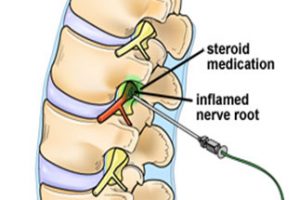
As patients are sedated precautions should be taken, including not eating or drinking certain fluids for several hours prior to the procedure and having a guardian available for discharge. A patient should contact the hospital for specific instructions.
Tenderness at the needle insertion site can occur for a few hours after the procedure and can be treated by applying an ice pack for 10 to 15 minutes once or twice an hour. In addition, patients are usually asked to rest for the remainder of the day on which they have the steroid injection. They should avoid driving for 24 hours due to the sedation.
Normal activities (those that were done the week prior to the epidural injection) may typically be resumed the following day. A temporary increase in the pain can occur for several days after the injection due to the pressure of the fluid injected or due to local chemical irritation.
It is not unusual in the first few hours to experience numbness or a loss of normal sensation in the legs or around the genitals. Patients will rarely have trouble passing urine but occasionally require a brief period of catherterisation.
Potential Risks of Steroid Injections
As with all invasive medical procedures, there are potential risks associated with lumbar steroid injections. In addition to temporary numbness of the bowels and bladder, the most common potential risks and complications include:
In addition to risks from the injection, there are also potential side effects from the steroid medication itself. These tend to be rare and much less prevalent than the side effects from oral steroids. Nonetheless, reported side effects from epidural steroid injections include:
When to Report Side Effects to a Doctor
All of these symptoms are atypical, and need to be assessed urgently.
For more information click here
In general, lumbar steroid injections are a low risk, useful, non-surgical tool to combat lower back pain and sciatica (radicular pain) caused by inflammation. A conservative analysis of patient outcomes suggests that a large percentage of patients will experience pain relief, although the exact degree of relief enjoyed depends on a number of factors. Their relative safety and efficacy makes steroid injections an integral part of the non-surgical treatment of low back and radicular pain.
Other non-surgical treatments can be found on the BASS website
This webpage will give you information about a lumbar discectomy.
What is sciatica?
Sciatica is pain down your leg caused by pressure on a nerve where it leaves your spine. This can happen if a disc in your spine becomes worn and develops a bulge (a ’slipped disc’) (see figure 1).

Figure 1: A disc bulge pressing on one of the nerves where it leaves the spine
What are the benefits of surgery?
You should recover more quickly from your sciatica. You may also be less likely to get sciatica again.
Are there any alternatives to surgery?
Many people get better in time without any surgery. Treatment involves painkillers and rest, followed by an exercise programme. If you have a lot of pain, you can also have a steroid injection in your spine.
What does the operation involve?
A variety of anaesthetic techniques are possible. The operation usually takes between three-quarters of an hour and an hour.
Your surgeon will make a cut in the centre of your lower back. They will part the muscles and remove a small amount of ligament and sometimes bone to get to the disc.
Your surgeon will remove the piece of disc that is pressing on the nerve.
What complications can happen?
1 General complications
2 Specific complications
How soon will I recover?
You should be able to go home the following day.
It is best not to do any heavy lifting after you have had back surgery, even if that is what your job involves.
Regular exercise should help you to return to normal activities as soon as possible. Before you start exercising, you should ask a member of the healthcare team or your GP for advice.
Most people make a good recovery from surgery and are able to return to normal activities.
Summary
The common cause of sciatica is a bulge on one of the discs in your spine that presses on a nerve in your lower back. If the pain does not settle on its own, your surgeon can perform a lumbar discectomy to remove the bulge.
Information taken from Ramsay Health Care website
This webpage will give you information about lumbar spinal decompression.
What is spinal stenosis?
Spinal stenosis is where the space in the centre of the spine (spinal canal) narrows. The spinal canal contains the nerves that leave the lower end of the spinal cord (see figure 1).
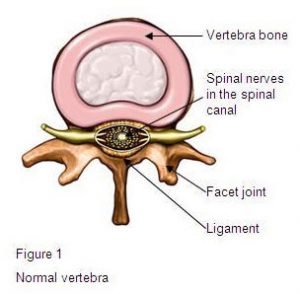
Figure 1 – Normal vertebra
A combination of arthritis in the spine, thickening of the ligaments, and bulging of the discs can cause this to happen. The nerves can get trapped in the spinal canal or where they leave the spine, causing weakness or pain in your legs.
What are the benefits of surgery?
You should be relieved of any pain or weakness in your legs.
Are there any alternatives to surgery?
If you have only mild symptoms, you may not need any treatment. Your symptoms are unlikely to get worse quickly. A few people will even get better with time.
If you have pain down your leg that is caused by pressure on a nerve in your lower back (sciatica), you can have a steroid epidural injection in your spine.
What does the operation involve?
You will usually have an MRI scan, to confirm the diagnosis and help your surgeon to plan the operation.
A variety of anaesthetic techniques are possible. The operation usually takes between an hour and an hour and a half.
Your surgeon will make a cut in the centre of your lower back. They will remove enough bone and ligament tissue from the back of the spine to free the trapped nerves.
Your surgeon may need to join the bones using a bone graft. Sometimes they will need to use metal screws and rods.
What complications can happen?
1 General complications
2 Specific complications
How soon will I recover?
You will normally be able to start walking on the first day after surgery. You should be able to go home after three to five days.
It is best not to do any heavy lifting after you have had back surgery, even if that is what your job involves.
Regular exercise should help you to return to normal activities as soon as possible. Before you start exercising, you should ask a member of the healthcare team or your GP for advice.
Most people make a good recovery from surgery. However, you may still get backache because of wear and tear in your spine.
Spinal stenosis can sometimes come back.
Summary
Spinal stenosis causes pain or weakness in your legs. If your symptoms are severe, a spinal decompression operation should relieve your symptoms and help you to return to normal activities.
Information taken from Ramsay Health Care website
Other Surgical Treatments can be found on the BASS website


